Field Experiments to Master Rock Identification: Five Hands-On Tests
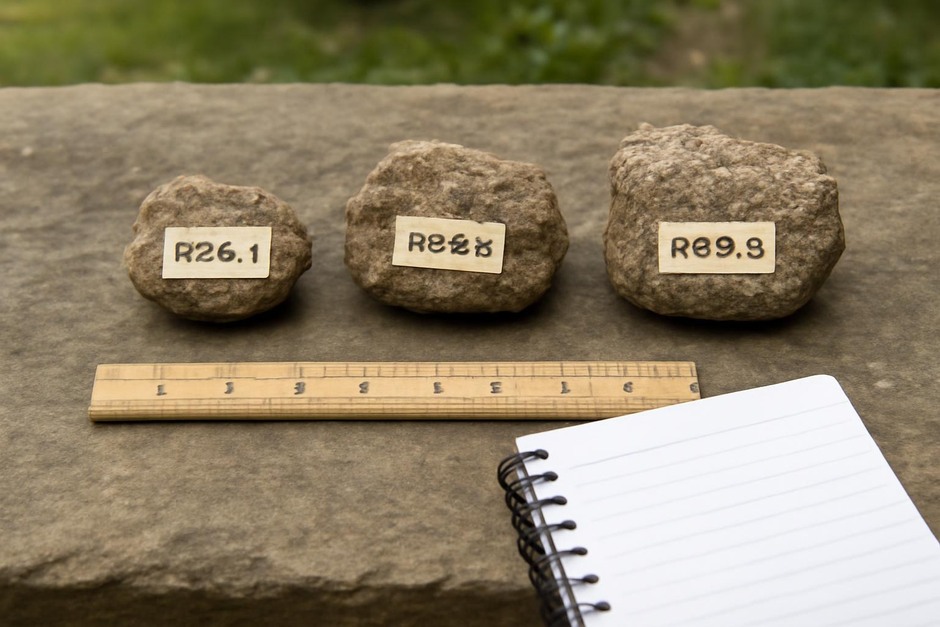
This short field course is designed as a series of small experiments you can do at an outcrop, roadside exposure, or a hand specimen to build a single practical skill: reliable rock identification and a first-order reading of origin. Each experiment is quick, repeatable, and uses minimal kit. Work through them in order—the observations accumulate into a robust conclusion.
What you’ll need
- Hand lens (10x) or strong magnifier
- Pocket knife or steel nail for hardness test
- Unglazed ceramic tile or porcelain shard for streak
- Small bottle of dilute vinegar (5–10% acetic acid) for reaction
- Field notebook and pen
- Safety glasses and gloves
Experiment 1 — Texture and grain size: the visual reconnaissance
Objective: Sort a specimen into coarse, medium, or fine textures and note visible minerals.
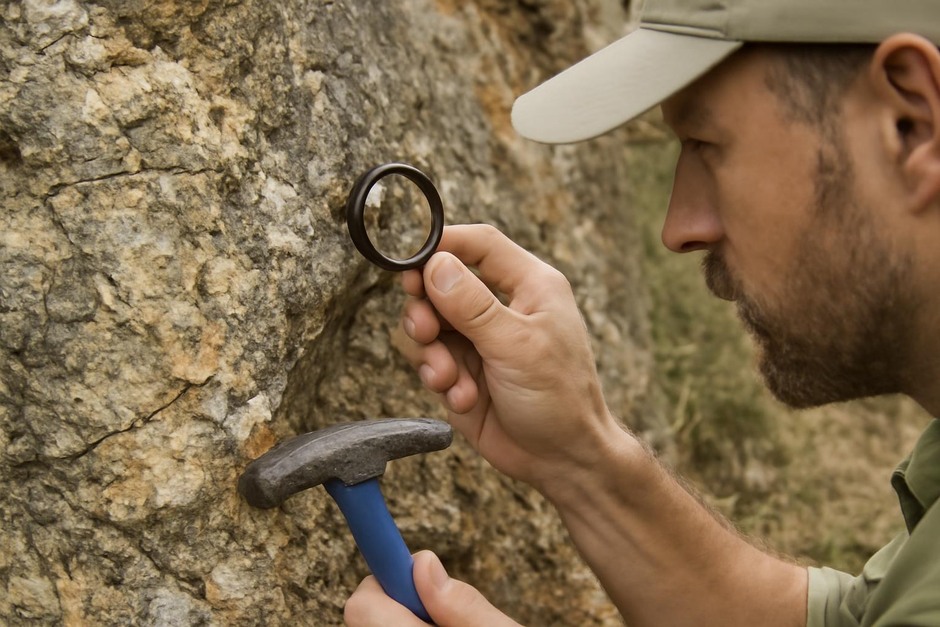
- Use the hand lens and naked eye. Estimate the largest grain you can comfortably see without magnification and with 10x.
- Record texture: coarse (individual crystals or grains >2 mm), medium (0.06–2 mm), or fine (<0.06 mm). Note visible crystals, layering, fossils, or glassy luster.
- Interpretation: Coarse-grained, interlocking crystals often indicate slow cooling igneous (e.g., granite) or metamorphic recrystallization (e.g., gneiss). Clastic grains with rounded or angular shapes suggest sedimentary origin; a glassy, vesicular texture suggests volcanic rock.
Experiment 2 — Hardness and scratch tests
Objective: Estimate relative mineral hardness to narrow down dominant minerals.
- Scratch the specimen with a fingernail (~2.5), a copper coin (~3), a steel nail (~5.5), and the knife blade (~6.5).
- Observe whether the tool leaves a scratch and whether the rock flakes or deforms.
- Interpretation: If the surface is easily scratched by a fingernail, it likely contains clay or gypsum; a coin-scratchable rock suggests carbonate or softer silicates; resistance to a steel nail points to quartz-rich materials (common in sandstones and many igneous rocks).
Experiment 3 — Streak color and surface behavior
Objective: Reveal true color of fine minerals and detect weathering rind influence.
- Rub a fresh, unweathered surface across the unglazed ceramic to produce a streak.
- Note the streak color: white, red/brown, black, or colored. Observe whether the rock powder is sticky, earthy, or glassy.
- Interpretation: Dark streaks often indicate mafic minerals or magnetite; red/brown powder suggests iron oxide coatings from weathering; a white streak can indicate calcite, quartz, or feldspar (use reaction test next).
Experiment 4 — Acid reaction: carbonate check
Objective: Test for the presence of carbonate minerals (calcite, dolomite), important in sedimentary interpretation.
- Place a drop of dilute vinegar on a fresh surface or powder produced by scraping. Watch for bubbling (effervescence).
- Record the vigor: strong fizzing (immediate, vigorous) suggests calcite; weak or delayed reaction suggests dolomite or small-grained carbonate; no reaction often rules out significant carbonate content.
- Interpretation: Positive reaction points toward limestone, fossiliferous sedimentary rock, or carbonate veins. Absence supports siliciclastic, igneous, or metamorphic interpretations.
Experiment 5 — Porosity and permeability quick check
Objective: Assess pore space and connectivity—useful for distinguishing compacted sedimentary rocks from dense igneous/metamorphic rocks.
- Saturate a small scraped pocket on the specimen with a few drops of water and observe absorption rate.
- If water vanishes quickly into the rock, note high permeability; if it beads and remains, the rock is low-porosity or coated.
- Interpretation: Highly porous, absorbing samples are typical of poorly cemented sandstones or vesicular volcanic rocks; resistant, non-absorbing samples are common for granite, basalt, and tight metamorphic rocks.
Putting the experiments together: a decision routine
After completing all five experiments, use your notes to build a concise diagnosis:
- Coarse interlocking crystals + hard + non-porous = likely intrusive igneous (granite) or high-grade metamorphic (gneiss).
- Fine-grained glassy or vesicular + resistant to acid + low porosity = volcanic (basalt, obsidian).
- Clastic grains visible, variable hardness, absorbing = sedimentary (sandstone); presence of fossils or effervescence = limestone.
- Layering, foliation, aligned minerals, and medium hardness = metamorphic (schist, slate).
As you repeat these experiments across different outcrops, you’ll train an observational shorthand: what to look for first, which quick tests give the most discriminating results, and when to escalate to field mapping or lab analysis. Record ambiguous cases—contradictions are often the most instructive.
Field notes on ethics and safety
Always collect responsibly: minimize sampling, obey local regulations, and avoid damaging protected sites. Use eye protection when scraping or striking rocks. If in doubt about a fragile or fossil-rich outcrop, photograph and describe rather than sample.
These five small experiments form a practical, repeatable workflow that builds confidence quickly. Start with familiar specimens near home, then apply the routine to unfamiliar outcrops—each run will sharpen your ability to read the Earth’s story written in stone.